
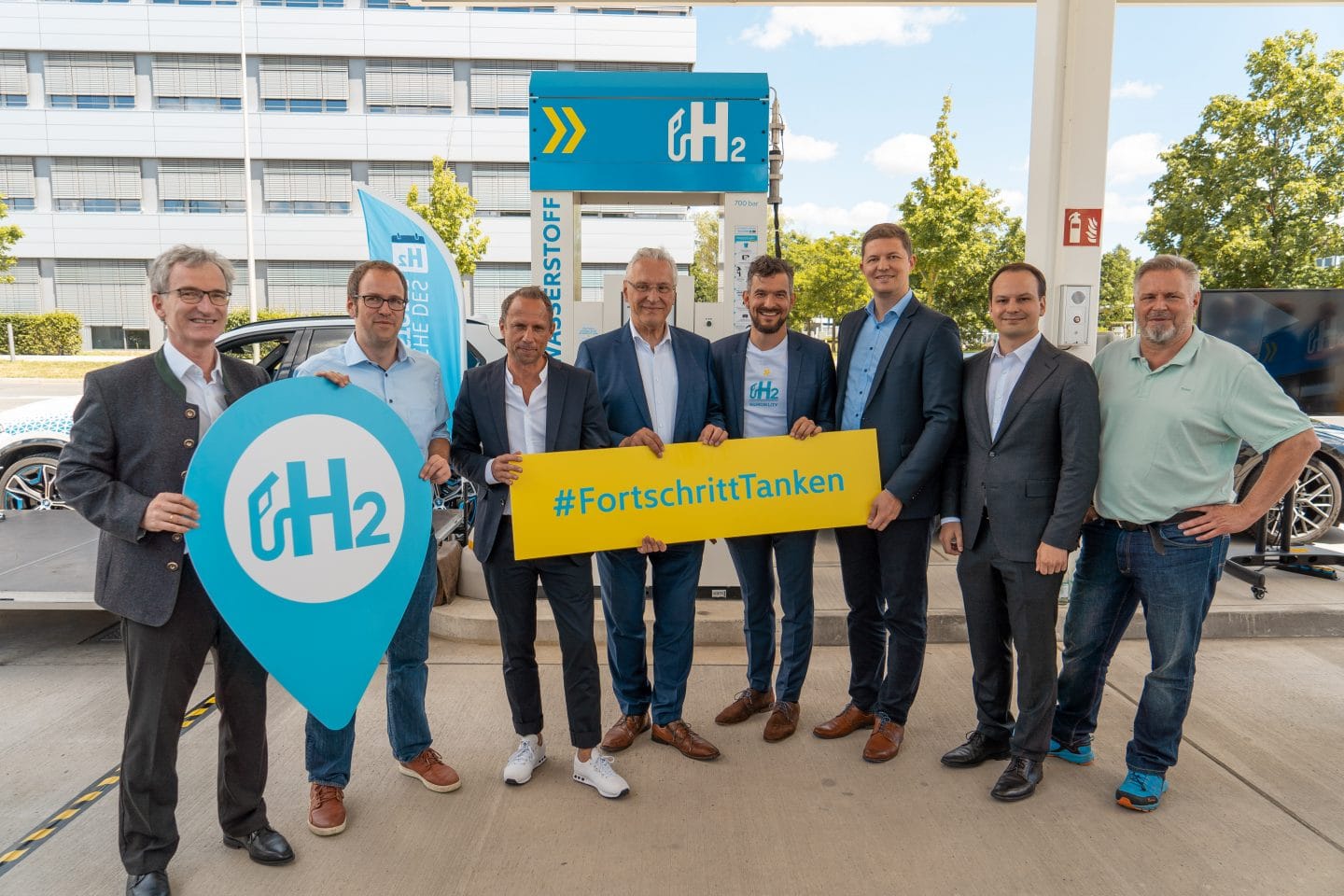
Drivers of fuel-cell vehicles can now refuel in Erlangen. H2 MOBILITY Deutschland, together with its shareholder Linde and partners Hydrogenious LOHC Technologies and SiemensEnergy, has launched ‘optimisation-mode’ operations at a filling station in Erlangen. Besides offering two pressure levels, the station uses electrolytically produced hydrogen (H2) and innovative Liquid Organic Hydrogen Carrier (LOHC) technology.
The hydrogen filling station at Henri-Dunant-Strasse 2 on the Siemens AG campus benefits from the region’s many activities related to hydrogen production and storage. For instance, Hydrogenious LOHC Technologies supplies the filling station with green hydrogen, bound in liquid organic carrier material (LOHC), which is stored at the station in conventional underground tanks. The Hydrogenious release system installed at the station handles the recovery and feeding-in of the LOHC-bound hydrogen. The station allows for 700-bar refuelling of cars and light commercial vehicles, as well as 350-bar refuelling for vehicles like buses. Erlangen was selected as a location in H2 MOBILITY Deutschland’s second funding round, the decisive factor being the city’s commitment to operating various hydrogen vehicles, including waste-collection vehicles and buses. Minister of Economic Affairs and Energy Hubert Aiwanger: “The success of Bavarian energy research is coming to fruition today with the opening of the world’s first hydrogen filling station to use the LOHC technology we are funding, and is setting standards for the upcoming market ramp-up. Thanks to LOHC technology, hydrogen can now be easily stored on site on a significant scale and also reused. With this, we have achieved a breakthrough.” Erlangen’s mayor Florian Janik said: “Hydrogen is a very promising future technology. In areas where traffic cannot be avoided, it can help to noticeably reduce CO2 emissions. We are pleased to be taking a pioneering step towards establishing the necessary infrastructure here in Erlangen with the opening of the hydrogen filling station.” City Manager Jörg Volleth is likewise pleased about the expansion of the hydrogen infrastructure in Erlangen. “The opening of the hydrogen filling station gives us an additional opportunity to make an important contribution to climate protection by converting our municipal vehicle fleet to zero-emissions drive types as well. We are therefore planning to expand our fleet of special-purpose vehicles with two fuel-cell vehicles in the next few years, and review a more extensive switch in this area.” The network of H2 filling stations continues to grow. As of today, there are 95 H2 stations in Germany, 21of them in Bavaria. The Erlangen filling station is conveniently located close to the Fürth/Erlangen motorway junction and thus to the A73 and A3. Alongside Berg bei Hof, Nuremberg and Fürth, the Erlangen site brings the total number of hydrogen filling station locations in the region to eight. The company responsible for building and operating the hydrogen filling station is H2 MOBILITY Deutschland, a key player in driving forward the expansion of the hydrogen infrastructure in Germany. The filling station technology comes from the industrial gas and technology company Air Liquide. The facility holds around 400 kilograms of hydrogen and is state of the art. Hydrogen is used to power fuel-cell electric vehicles (FCEVs). Its advantages are: no noise and no pollutants while still offering the same ease of use, speed, and range as cars with petrol or diesel engines. Fuel-cell electric cars have ranges of 500 to 700 kilometres and are refuelled in just three to five minutes. Hydrogen thus offers the possibility of expanding the fuel supply in the transport sector in a climate-friendly way, because hydrogen – especially if it is produced using renewable sources – can help to significantly reduce climate-damaging CO2 emissions. For the construction of the hydrogen station in Erlangen, H2 MOBILITY Deutschland received funding of €984,898 under the National Hydrogen and Fuel Cell Technology Innovation Programme (NIP) of Germany’s Federal Ministry of Digital and Transport (BMDV).